NO AI TRAINING: Without in any way limiting the author’s exclusive rights under copyright, any use of this content to “train” generative artificial intelligence (AI) technologies to generate text is expressly prohibited. The author reserves all rights to license uses of this work for generative AI training and development of machine learning language models. This content is not made using generative AI.
Disclaimer: I am not a medical professional, and this post is not intended to provide medical advice, nor to treat, prevent, or cure any disease. It is simply a disabled person sharing their thoughts and knowledge. Still helpful, in my book.
Does chocolate cause migraines? Can it help them? Should you ever eat chocolate again? Does chocolate contain brain-strengthening super parasites?
These questions haunt many of us who have migraines, as well as those wanting to learn more. Except maybe the last one. I might have made that up.
I like to be silly when talking about migraines, because yes, they suck. Humor is part of my coping. Plus, I find it makes it easier to talk to others about them. Since migraines are so poorly understood, it provides a starting point.
So, what is the relationship between chocolate and migraines? Using my own experiences, chats I’ve had with others, and information from the scientific review I just linked, let’s explore.
Table of Contents:
- Does chocolate cause migraines?
- Can chocolate help migraines?
- Chocolate: only one part of the migraine toolkit.
Does chocolate cause migraines?
Yes. And no. Not the answer you wanted, huh? Me neither.
Like any food, chocolate can be a migraine trigger. And, whether from an expectation bias or biological cause, it is one of the more commonly reported food triggers, along with red wine and cheese. Some of the best foods out there!
Still, the review found that only a small amount of migraine havers experience chocolate as a trigger—with the highest number being 33%. No two people experience migraines exactly the same, and their triggers vary as well. A safe food for one person can be a trap for another.
Additionally, it’s unclear whether chocolate is actually causing the migraine, or if it’s simply an effect of a premonitory symptom. It’s possible that when a migraine is coming on, someone gets a craving for chocolate. They eat the chocolate, get a migraine, and… well, you can do the math.
So should you avoid chocolate? That’s not my decision to make! Personally, though, I love the stuff. The darker the better.
Can chocolate help migraines?
Yes, and no, again. Ugh.
When it comes to chocolate and migraine headaches, so much varies person to person, like anything involving migraines. If chocolate is a trigger for you, it obviously isn’t going to help.
But for some people (myself included), chocolate can be very helpful. Typically, dark chocolate has more benefits. More on that in the next section.
As with any treatment or food, you have to consider the amount you have. For many of us, caffeine can help relieve migraine symptoms. But too much caffeine can lead to migraines, as can caffeine withdrawal. It’s the same with chocolate: even if it helps you, eating too much could make your migraine worse.
How much is too much chocolate for a migraine? Sadly, you have to do some trial and error to figure that out.
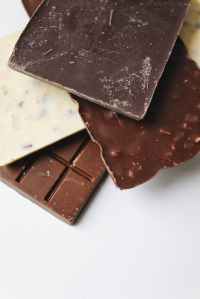
When I get a migraine, you’ll often find me munching on some extra dark chocolate. It helps reduce my pain and nausea. Plus it just tastes good, which helps me feel a bit better. I like it so much that people keep gifting it to me, and my collection is growing:

(Post continues below)
Don’t want to miss a post? Subscribing helps me out and ensures that you receive email updates for every post, with no extra unwanted emails. Be sure to check your inbox for a verification email.
Why does chocolate help migraines?
As with most things surrounding migraine, we don’t know the exact relationship between chocolate and migraines. But the review does provide some possibilities.
First, chocolate is high in minerals and vitamins like magnesium and riboflavin. Magnesium has been shown to be beneficial in aiding pain and chronic conditions. Riboflavin can be good at reducing frequency of migraine attacks.
Tryptophan, also found in chocolate, can help boost and maintain serotonin levels. Since migraine havers typically have lower serotonin, and lower levels can lead to migraine, getting this boost could also be a boon.
Dark chocolate is usually better because it contains more cocoa, meaning more of all the above. Plus, cocoa contains caffeine, and while it’s not nearly as much as a cup of coffee, it can also have soothing effects.
Lastly, chocolate is just a great sensory experience. Making your bodymind feel better in one way can help cope with the pain and other drawbacks of a migraine attack.
I’ve talked about chocolate so much, I’m starting to feel like that character from SpongeBob when they’re selling chocolate bars. Chawklate!
Chocolate: only one part of the migraine toolkit.
While chocolate is a fantastic tool, if it’s the only one in your kit, you’re going to suffer more. Managing migraines means using a variety of tools, from meds to supplements to habit changes.
Sometimes medical interventions can work wonders. Sometimes they don’t work, or you don’t want to deal with side effects. It’s totally ok to try more natural remedies too. You can even try natural things with the meds!
Most migraine tools are split into two categories: preventative and reactive. I’ll share my toolkit for both as an example. Maybe you’ll find something you like.
Preventative measures:
- A monthly injection of Emgality
- Avoiding red wine, high-vinegar foods, and high amounts of garlic
- Avoiding triggering scents, for example in cleaning supplies or candles
- Giving myself regular breaks from looking at a screen
- Blue light filters in my glasses, as well as sunglasses outside
- An earplug in my left ear in loud/overwhelming environments
- Doing what I can to reduce stress levels
- Blackout curtains for sleep
Reactive measures:
- Injections of Sumatriptan
- Ondansetron for nausea
- Chocolate
- Ginger tea to help with nausea
- Brown sunglasses to use indoors
- Night light filters on all my devices
- Flexibility to take off, sleep more, and do what else I need for recovery
- Small amounts of caffeine or Tylenol to help with pain
- Caring and understanding friends who provide support in what ways they can
Satisfyingly, I was eating dark chocolate while initially drafting this post. I didn’t have a migraine though, it was just a snack. I hope you’ve learned something new today. Even better if it’s something helpful!
What are other items in your migraine toolkit? What questions do you have for me? Leave a comment down below to let me know! And if you liked this post, make sure to subscribe so you don’t miss the next one.

 Ashton Rose