NO AI TRAINING: Without in any way limiting the author’s exclusive rights under copyright, any use of this content to “train” generative artificial intelligence (AI) technologies to generate text is expressly prohibited. The author reserves all rights to license uses of this work for generative AI training and development of machine learning language models. This content is not made using generative AI.
As I settle into 2025, my energy levels are low. Emerging from the holiday burrow while still recovering from a series of illnesses takes time. So I wanted to do something simple and fun to start off the year.
This list is simply five of my favorite disabled characters across different media. Not the absolute best representation, or most reviewed, or anything else. Just my personal favorites.
Warning: this post contains spoilers related to each of the characters’ stories. Proceed at your own risk.
Table of Contents:
- 1. Eda Clawthorne (The Owl House)
- 2. Toph Beifong (Avatar: The Last Airbender)
- 3. Chandresh Christophe Lefèvre (The Night Circus)
- 4. Chai (Hi-Fi Rush)
- 5. Val (The Power)
1. Eda Clawthorne (The Owl House)
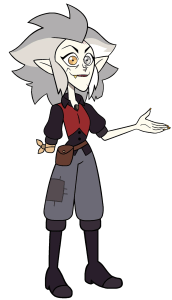
Of course The Owl House is going to be on a list about disability representation. I could talk for hours about this show’s complex portrayal of various disabilities, but I’ll spare you that, and instead recommend this wonderful post by another queer disabled writer.
Eda takes the position of my favorite for two reasons. One, she is an absolute icon with a gender I greatly envy. And two, her curse is brilliantly woven into the story as a clear metaphor for chronic illness.
Early on, we learn that Eda’s curse can be managed. Over the show, we see how she manages it, and what happens when she runs out of her medica— I mean, potion. When we meet Eda’s mother, the clash between cure and acceptance is made painfully clear, in a narrative that many chronically ill people could relate to. Plus, when Eda loses her arm, she gets a prosthetic hook!
One of Eda’s best features, in my opinion, is that although she’s internalized a lot of shame for her curse, she is also blunt about it, and learns to be more open throughout the show. Eventually, we see a radical acceptance that so few stories ever represent.
2. Toph Beifong (Avatar: The Last Airbender)
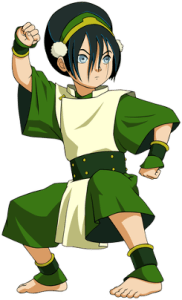
I grew up watching this show on repeat, and in a culture flooded with messages of “disability=deficiency”, Toph was very likely the first time I realized that having a disability didn’t always make someone weaker.
Toph is the strongest bender in all three seasons of the original show. I said it, and I’m willing to die on this hill. She literally invented a new type of bending to get away from two annoying men. It’s my belief that the only thing stopping her from wiping the floor with Azula and Ozai was not wanting to embarrass her friends.
Unlike in many TV shows with disabled characters, Toph is not reduced to being only her blindness, and it is very often her making jokes about her vision at other peoples’ expense. She is a fleshed-out character with an entire personality that goes beyond being blind.
But, crucially, her disability is also not ignored. Not only do her unique strengths (sensing vibrations, lie detecting) save the group multiple times, but she faces challenges, sometimes small ones, due to her lack of vision. Challenges that other characters usually help her with. Toph presents a disability narrative that includes the complicated messiness of disability, rather than just picking one facet of it.
(post continues below)
Don’t want to miss a post? Subscribing helps me out and ensures that you receive email updates for every post, with no extra unwanted emails. Be sure to check your inbox for a verification email.
3. Chandresh Christophe Lefèvre (The Night Circus)

Now, as much as I love Erin Morgenstern and The Night Circus, I will admit that I’m not sure Chandresh was meant to be read as a disabled character. However, that reading is entirely plausible, and I personally think it provides a lot of depth and richness.
Throughout the novel, Chandresh’s mental decline is clear. While this decline is visibly caused by another character’s actions, it’s possible that Chandresh had a (potentially asymptomatic) condition that sped up, or worsened, his deterioration.
By his end, rationality and memory seem to have left Chandresh. He is constantly confused, and his belief that real experiences were hallucinations could easily parallel something like schizophrenia or dementia.
His unknowing compatriots too readily write off his decline as a worsening of his long-standing eccentricity. But Chandresh also makes us confront a very hard truth about the way disabled people are sometimes treated. Marco’s cruel manipulation of him takes a huge toll. Just as some disabled folks, especially those of us with mental disability/illness, get used by others for their own gain, with little regard to our health, desires, or safety.
4. Chai (Hi-Fi Rush)
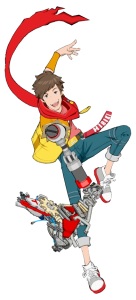
Do you know how excited I was when I started this game and realized I would get to play as a disabled character? Disabled characters in video games are already so rare, and playable ones seem to be one in a million.
Hi-Fi Rush doesn’t often explicitly use the word disabled, nor does it have a particularly complex disability plot. However, there’s no denying that Chai is disabled. He gets an experimental procedure to repair an impaired arm and ends up with a prosthetic that he can turn into a badass butt-kicking guitar.
You don’t have to dig deep to find metaphor: Chai is labeled a “defect” from the start. The main plot revolves around evil techno-capitalists trying to hunt Chai down to destroy this “defect” and protect their company image.
Another fun layer of speculation is in the game’s beat-synced visuals. Sure, these bright colors and shapes could just be video game shenanigans. But if we take them as diegetic, then Chai could also be experiencing a type of synesthesia, one that aids him in combat and creates a much more vibrant world.
5. Val (The Power)

Horror is my favorite film/TV genre. I will be the first to admit that it is also the genre most steeped in ableism. As such, good disabled representation in this genre is beyond scarce.
Too often, horror is based upon a fear of the grotesque, the deformed, and the other. When disabled characters do appear, they’re either a ridiculous stereotype, the villain, or both. I would list examples, but I’d be listing at least 30% of the horror movies I’ve seen.
The Power turns all that on its head.
Val, a nurse in 1970s London, suffers from severe PTSD due to awful childhood experiences. The story weaves that trauma with supernatural occurrences and a troubling mystery, and it does so beautifully.
Throughout the film, Val’s PTSD presents many barriers: others don’t always believe her, she has panic attacks, and she struggles to manage the stress of a haunting. We see how viscerally this affects her. Her PTSD is never presented as a superpower, but it is her past that gives her the conviction and strength to see this mystery through to the end.
In a rare move for horror, The Power presents a complex disabled character who isn’t the bad guy. Its pacing is also phenomenal, and it functions both as supernatural and psychological horror, evoking fear of the spiritual world and fear of our fellow humans at the same time.
Even as I wrote this, I thought of so many other characters I want to put on here, but I wanted to keep it short! An honorary mention goes to Hiccup and Toothless from How to Train Your Dragon. They would have made it on the list (as a pair), but I was trying to provide a variety in terms of media and disability portrayed.
What other characters would you add to this list? I’d love to know! You can leave a comment down below or on my Instagram (@ashtonrosewrites) or Facebook (@ashtonrosewritesfb). And if you liked this post, make sure to subscribe so you don’t miss the next one.

 Ashton Rose